Spreadly Trade Show Pulse (2026, H2): What’s Really Holding Trade Show Teams Back
4 minutes
29th of June 2026
In this article:
- TL;DR: The key numbers at a glance
- The top 5 takeaways from the Pulse Report
- Top teams vs. bottom teams: what really makes the difference
- Quick wins: what moves the needle most
- Conclusion
Today, we’re excited to publish the Spreadly Trade Show Pulse 2026 (H2) — our first Pulse report on trade shows, including both the benefits and the challenges for companies. The findings are based on 37 interviews, with 54% of participants from executive leadership; 68% of those exhibit at trade shows two or more times per year.
If you’ve exhibited a few times, you know the pattern: conversations happen at the booth. Afterwards, the question remains why, in the end, too little real pipeline shows up in the CRM.
Here are the key insights from the report:
TL;DR: The key numbers at a glance
- 65% use trade shows primarily for new leads/pipeline.
- 27% can measure the trade show’s later contribution.
- 51% don’t qualify leads directly at the booth.
- 57% follow up later than 48 hours after the event (only 5% on the same day).
- 54% use a CRM for capture — but only 11% have an end-to-end automated trade show workflow.
- 43% primarily want better lead quality (only 8% want more volume).
The top 5 takeaways from the Pulse Report
1) Trade shows are a sales channel with pipeline expectations
In the Trade Show Pulse, the goal is very clear: 65% name new leads/pipeline as their most important trade show objective. Partnerships, brand, or existing-customer nurturing are far behind.
That matters because it sets the benchmark: if a trade show is a sales channel, then leads must be qualified, followed up, and measurable.
2) The biggest problem isn’t quantity — it’s quality
Many teams invest in trade shows, but later can’t clearly show what came out of them. In the report, only 27% say they can measure the trade show’s contribution afterwards.
That’s the moment when budget discussions become unnecessarily hard. Because without measurement, you’re often left with: “It (didn’t) feel like it worked.”
3) The first breakdown happens at the booth: qualification is missing
51% don’t qualify leads directly at the booth — either not at all, or only as a free-text note. That sounds like a small process detail, but it’s critical. Because after the event, the context is missing:
- What was the concrete need?
- How urgent is it?
- What role does the person actually have?
- What’s the next sensible step?
When that information is missing, a trade show conversation quickly becomes just a record — and “pipeline” turns into a “contact list.”
4) Follow-up often comes too late
In the Trade Show Pulse, 57% take longer than 48 hours to send the first follow-up. Only 5% respond on the same day. But the first two days are exactly the window when the conversation is still fresh and the next step is easiest.
In short: speed-to-first-touch is a lever many teams leave on the table. Not a new insight — but many teams still struggle to execute on it.
5) The tools exist — but the workflow doesn’t
Many teams have a CRM. Still, the trade show process is often not end-to-end. 54% use a CRM to capture leads, but only 11% have a fully automated process from capture at the booth through to the system.
A CRM alone is table stakes. What matters is whether the trade show is actually converted through the process.
Top teams vs. bottom teams: what really makes the difference
In the report, we compare teams with very high ROI (>4x) to teams with low ROI (<2x). The difference isn’t “even more tools,” but a few clear fundamentals. The biggest levers are:
- Digital capture at the booth: Top 62%, Bottom 0%
- Live qualification at the booth: Top 54%, Bottom 17%
- Follow-up within 48 hours: Top 69%, Bottom 33%
- Automated CRM process: Top 54%, Bottom 17%
And one point that sparked a lot of debate in many conversations:
- Marketing automation isn’t a silver bullet: Top 15%, Bottom 67%
Meaning: if data and context are missing at the front, automation at the end mainly scales one thing — the wrong input.
Quick wins: what moves the needle most
If you compare different solutions by “impact on ROI vs. effort,” there’s one clear lever that delivers a big effect with relatively little effort.
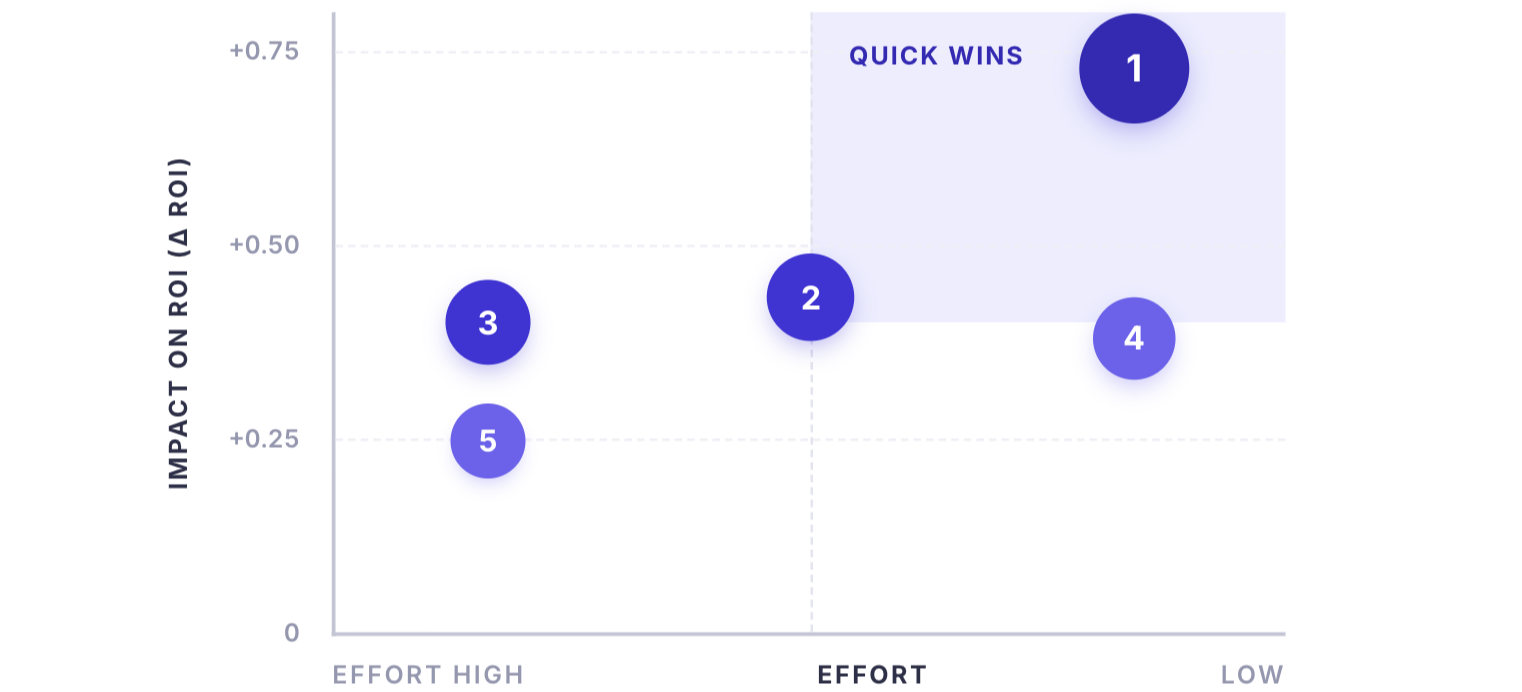
- Digital lead capture at the booth (biggest impact for the least effort)
- Speed-to-first-touch (≤ 48h)
- Automated CRM process
- Live qualification (scoring/checklist)
- Having a CRM at all (baseline requirement)
Conclusion
Trade shows deliver conversations. Pipeline only happens when the process works.
The Spreadly Trade Show Pulse makes it pretty clear: digital capture, live qualification, and fast follow-up are the fundamentals to get the most out of exhibiting at a trade show.
Download the Spreadly Trade Show Pulse Report to get the full details and results of our survey.